
How to Read Drum Notation (3): How to Read Rests
How to Read Drum Notation (3): Rests
In the previous article we learned quarter, eighth, and sixteenth notes and how many hits fit in a beat.
This piece introduces another common symbol in drum notation—the rest.
When I first looked at drum charts, seeing a rest made me instinctively think "don’t play, so stop."
But a rest doesn’t mean stop counting the beat; it means "no sound is produced during this time, while the pulse continues."
So when you see a rest your hands may pause, but the internal pulse must keep going. If you don’t count the silent beat clearly, the next note can easily come in early or late.
1. Quarter Rest
In 4/4, a quarter rest equals one beat of silence.
If the second beat is a quarter rest, you still need to count internally:
1 2 3 4
Ta (hmm) Ta Ta
Even though you don’t play on beat 2, you should still count "2." If that feels awkward, you can mentally say "hmm" so you don’t lose the placement of beat 3.
Follow the examples below and count along.
2. Eighth Rest
An eighth rest equals half a beat. If we subdivide by eighth notes:
1 & 2 & 3 & 4 &
If the "&" after beat 1 is an eighth rest, it becomes:
Ta (hmm) Ta Ta (hmm) Ta Ta Ta
You don’t skip the "&"—you still count it mentally, you just don’t play there. Backbeats, syncopation, and "missing 2" patterns often use this silent subdivision.
3. Sixteenth Rest
A sixteenth rest equals a quarter of a beat. When counting sixteenths:
1 e & a
On the snare you might say Ta Ta Ta Ta
Any of those four subdivisions can be a rest. If the "e" is silent, it becomes:
1 (silent) & a
Ta (n) Ta Ta
Sixteenth rests are very short and easy to miss at higher tempos. I usually slow the BPM, count all four subdivisions clearly, and then check which positions are played and which are silent.
Below is the "Ta (n) Ta Ta" feel so you can hear the rest; try speaking it aloud:
Ta (n) Ta Ta | Ta (n) Ta Ta | Ta (n) Ta Ta | Ta (n) Ta Ta
4. Half Rest and Whole Rest
A half rest equals two beats; a whole rest in 4/4 usually means the entire bar is silent.
Even when a whole bar has no notes, you must still count all beats internally:
1 2 3 4
Only after counting all four beats can you accurately come in on the next bar. Whole-bar rests are common where the band stops and only other instruments play.
Below is the symbol for the whole rest

Below is the symbol for the half rest
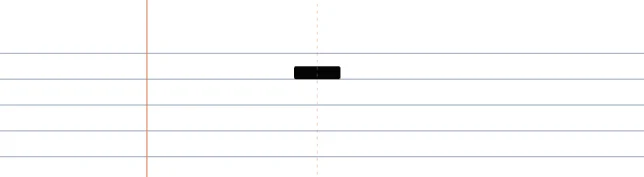
Rests, like notes, have different durations:
Quarter rest: one beat
Eighth rest: half a beat
Sixteenth rest: quarter of a beat
Half rest: two beats
Whole rest: entire bar
The most important idea about rests is: "not playing doesn’t mean the pulse stops."
Sound may disappear temporarily, but the metronome and song keep moving.
When reading drum charts I count notes and rests together: play on note positions,
mentally count the rest positions. When you can count the silent beats consistently,
you’re less likely to rush or fall behind on offbeats, syncopation, or sudden stops.
A rest isn’t doing nothing—it’s holding the pulse quietly and accurately. 🥁