
How to Read Drum Notation (5): What Are Bar Lines? Where Do I Start Reading a Drum Chart?
In the previous posts we covered staff positions, notes, rests, and time signatures.
But when beginners get a full drum chart, a very practical question often pops up:
“So… where do I start reading? 😆”
Besides all the notes on the staff, you’ll see vertical lines running through the five lines.
What are those lines?
Why is the chart divided into little boxes?
Today we’ll look at something that seems small but is very important—bar lines.
1. What is a bar line?
On a drum chart you’ll see many vertical lines cutting across the staff.
These are:
bar lines (Bar Line)
Their job is simple: they separate the music into segments.
The space between two bar lines is called a:
measure / bar
Think of it like punctuation in a sentence.
Without commas or periods the text would be hard to follow.
The same goes for drum charts.
With bar lines we can clearly tell:
“Okay, this is one measure.”
2. How many beats in a measure?
That depends on the time signature we covered previously.

The most common is 4/4, which you can think of simply as:
one measure has 4 beats.
So when you see 4/4, count in your head:
1, 2, 3, 4 | 1, 2, 3, 4 | 1, 2, 3, 4…
You can think of the “|” as the bar line.
Every time you finish four beats, you move to the next measure.
For example, a basic 8-beat:
1 & 2 & 3 & 4 & | 1 & 2 & 3 & 4 & |
Even though you say many “&”s, the main beats are:
1, 2, 3, 4.
After counting beat 4 you enter beat 1 of the next measure.
3. Why is it important to know measures?
Because when reading charts, practicing, or discussing parts with others, people often refer to “measure X” to locate a spot.
For example:
“Let’s start from measure 9.”
You can go straight to measure 9 instead of hunting from the top:
“Wait… which snare is that? This one? Or the next line? XD”
A full song can have dozens or even hundreds of measures.
Without the concept of measures, a full chart can be overwhelming.
So get into the habit of reading “measure by measure.” It makes things much easier.
4. Where do you start reading a drum chart?
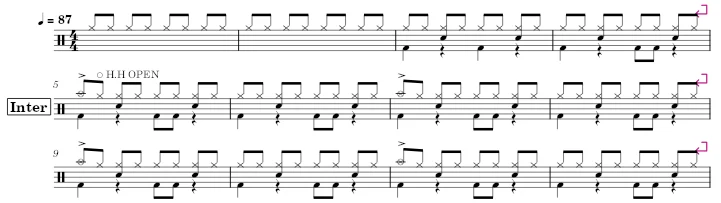
It’s simple:
left to right, top to bottom.
Just like reading a regular text.
Start at the left of the first line and read to the right.
When that line is done, go to the left of the next line and continue.
In short:
left → right → next line left → right
The first time you scan a chart, don’t try to understand the whole page.
First find:
“Which measure are we playing now?”
Then look at the 1, 2, 3, 4 beats inside that measure to see what to play.
That makes it much simpler.
5. Don’t read the whole line at once—learn to read “one bar at a time”
This is an important mindset for beginners.
Seeing a whole line full of notes often makes people think:
“What is all this… so many notes.”
But don’t try to take it all in at once.
Start with the first measure.
If it’s 4/4, find:
beat 1 → beat 2 → beat 3 → beat 4
Once you understand those four beats, move to the next measure.
Break it down and you’ll see a long, complicated line is just many groups of four beats stitched together.
So when you see a long chart, don’t be intimidated.
Take it measure by measure. 🥁
6. Three things beginners should check first when they get a chart
If it’s your first time with a chart, don’t rush to play.
Look at three things first:
1) Check the time signature
Confirm how to count each measure.2) Find the bar lines
Treat the whole chart as “many measures” rather than a big pile of notes.3) Count beats from the first measure
1, 2, 3, 4—check what drum hits are on each beat.
Once you understand it, start playing slowly.
You don’t need to match the original track’s speed right away.
Understand first, then play slowly—this is usually more effective than forcing the original tempo. XD
Finally,
bar lines themselves aren’t hard.
They’re just straight lines.
But when you understand:
bar line → divides music into measures
4/4 → one measure has 4 beats
drum chart → read left to right, top to bottom
then a full chart won’t just look like:
“so many notes… 😵💫”
Instead you’ll start breaking it into:
measure 1, measure 2, measure 3…
and work through each measure until you understand it.
No need to tackle the whole song at once.
Understanding just one measure today is already progress. 🥁